*Note: There are spoilers in this review!
Much of the current internet discussions around A24’s newest film, Primetime, starring Robert Pattinson as To Catch a Predator host, Chris Hanson, have been dominated by conversations around whether or not the film supports or undermines people who hunt down child predators, which is unfortunate because it misunderstands what I believe is the actual point of the film: to discuss the morality behind using real-life issues for entertainment, and what happens when those issues are intertwined with fame, ratings, and money.
I believe there is a much more interesting conversation to be had around Primetime and it’s thematic comparisons to the critically-acclaimed, multi-Academy Award-winning film, Network (1976), directed by Sidney Lumet. Almost fifty years after it’s release, the film’s themes are relevant more than ever: how corporate greed has taken over and destroyed many parts of our lives, how the media has dehumanized people and desensitized the general population to tragedies and controversial behavior, and most importantly, how broadcast companies have commodified news and turned it into entertainment rather than informative content meant for public service. Primetime never really dives into any of these topics on a deep level the way Network does, but the similarities in themes prove how prescient screenwriter Paddy Chayefsky was when writing his screenplay in the 70s.
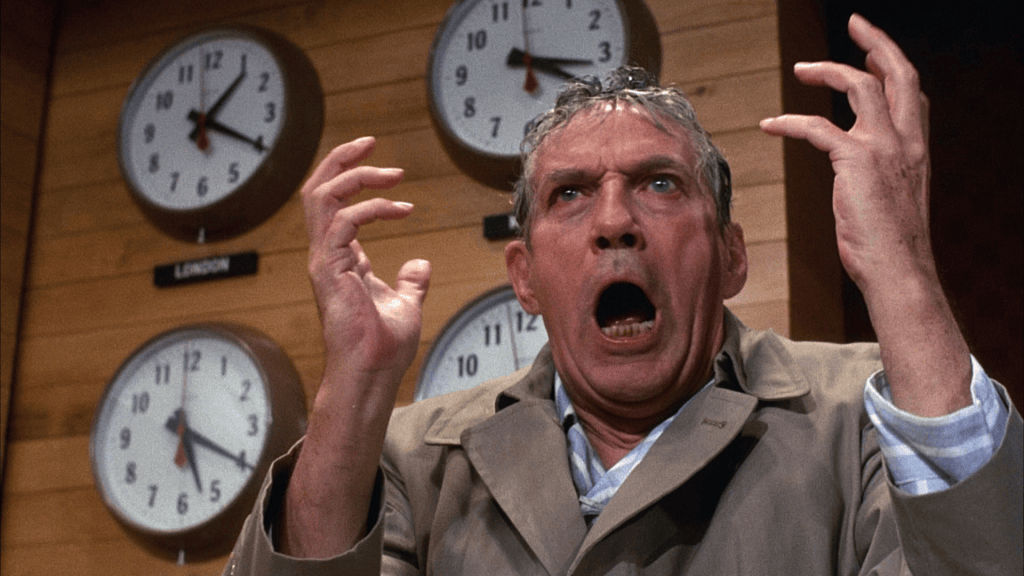
At the start of Network, Howard Beale (played by Peter Finch, who won the Academy Award for Best Actor in a Leading Role, the first to ever do so posthumously) finds out he’s being laid off from his position in two weeks due to low ratings, which leads him to announce during his next broadcast that he will kill himself on live television next week. UBS, the network, tries to get rid of Beale immediately, but Beale’s colleague and news division president, Max Schumacher (played by William Holden, who was also nominated for Best Actor) steps in to help give Beale a dignified farewell.
However, during the following night’s broadcast, Beale goes on a rant about the terrible state of the economy and the eroding of the fabric of society, ending with a desperate plea to the audience watching at home to stick their heads outside of their windows and yell at the top of their lungs, “I’m as mad as hell, and I’m not going to take this anymore!” He takes over the nation with his impassioned speech, and goes on to host a new program, The Howard Beale Show, where he continues to preach his messages as “The Mad Prophet of the Airwaves”.
At the beginning of Primetime, we find our protagonist off to a much different start. To Catch a Predator’s host, Chris Hansen (played by the charismatic Robert Pattinson), is at the top of the ratings, drawing in millions of viewers every episode. The network decides to air the show during primetime blocks, competing against major TV shows like Lost.
I never watched To Catch a Predator because I was only in elementary school when it aired, and I had a hard time even convincing my parents to let me watch Spongebob Squarepants and Hannah Montana (the former because it used “bad words” like “stupid”, and the latter because it portrayed “high school romance”, which an elementary school student should never watch). However, I do know that this show was a big part of many people’s lives, and that it was an undeniable sensation, which the film shows. With a primetime slot in hand, Hansen (both in the movie and in real life) makes it his mission to make his show the number one show on television.
______
After reaching it’s initial high, The Howard Beale Show eventually comes back down to earth and finds itself at a crossroads. Howard Beale gained his popularity by giving a voice to the average frustrated American, and continued to do so with success until the show starts to slip in the ratings. He hits a major hiccup when he discovers that his network’s parent company will be bought out by a Saudi conglomerate, and tells his followers to all send letters to the White House stating their disapproval. UBS begins to panic because they need this deal to happen to cover their major debt, resulting in a pivotal scene with CCA president Arthur Jensen (brilliantly played by Ned Beatty, who was also nominated for an Academy Award) where he tells Beale that he must change his message to a pro-corporate one so he doesn’t upset the balance of the world. From then on, Beale goes from being “mad as hell” in an angry way, to being “mad as hell” in a crazy/unhinged way, basically believing he is a Christ-like figure among mortals, which unfortunately leads to his demise as he is shot to death on live television by a terrorist group.
Likewise, To Catch a Predator finds itself needing to catch bigger “whales” as the show continues in order to maintain its ratings. Xavier Von Erck (played by Matthew Maher) attempts to catch a bigger “whale”, and stumbles upon a predator who turns out to be assistant district attorney Bill Conradt in Texas. Hansen makes a decision to move the operation to Texas to catch this “big whale”, and due to the pressures from the network to find something bigger and improve ratings, ends up working with the local police department and goes directly to Conradt’s house. Before Hansen was able to catch him in the act and do the normal “you’ve been caught” interview scenario, Conradt commits suicide.
______
Both movies explore the spectacularization and desensitization of important issues for the public.
In Network, programming chief Diana Christensen (played by Faye Dunaway, who won Best Actress for this performance) proudly proclaims that “All [she] want[s] out of life is a 30 share and a 20 rating.” Her sole goal is to create highly rated television programs, no matter what. Aptly summarized by Schumacher, “[She’s] television incarnate…indifferent to suffering, insensitive to joy.”
During a weekend with Schumacher, where their affair begins to blossom, all Christensen can talk about is television. The deals she’s doing, the ideas she has for new programs. Her whole life is quid pro quo. When she decides to partner with a terrorist group to launch a new program called The Mao Tse-Tung Hour, it’s not to platform and amplify a message she personally believes in. She just wants another hit television show. Something “shocking” and “anti-culture” that will tap into the anger of the American public.
No moment showcases Christensen’s lack of morality and television’s spectacularization of current events more than when she is forced to figure out how to get rid of Howard Beale and his show, as ratings began to decline. To revamp the network’s ratings, Christensen, along with other people at the network, make the decision to hire the terrorist group from The Mao Tse-Tung Hour to assassinate Beale and use that footage to launch the second season of The Mao Tse-Tung Hour, which, yes, is absolute insanity.
Network makes a statement through Diana Christensen—television and the people who run it have distorted the way we deliver the news to the public by commodifying it and turning it into entertainment. Instead of treating the delivering of news and truth as an obligation to the people, networks have resorted to scandalizing and sensationalizing headlines, trading their morals for high ratings.
The closest Primetime gets to diving deeper into the topics of sensationalization and desensitization of important issues is through Andie Bender (played by Merrit Weaver, who I thought had a standout performance). This character is actually the reason why I immediately thought of Network while watching Primetime.
Similar to the character of Christensen, Bender is always thinking about the show and its performance. When Hansen goes over Bender’s head to change plans and head to Texas instead of New Jersey to pursue this “big whale”, she’s not worried about catching predators. She instead, voices her frustrations that this move would send the wrong message to the broadcast company, that she is unfit to do her job.
In the penultimate moments of the movie, when the police officers and the crew of To Catch a Predator are about to break into assistant district attorney Conradt’s house, Bender isn’t concerned with catching the predator and holding him accountable. She’s only worried about how to film the arrest and how she can get the interview with the predator, and focuses on finding a way to attach cameras to all of the cops’ guns so they can get a good shot for the show.
When Conradt commits suicide, there’s no moment of shock. Bender’s only thinking about how she can salvage the show, and begins to brainstorm ways she can interview the cops in place of the interview with the predator that normally takes place, showcasing who she is at her core—someone who only cares about the ratings, without any regard for how she has to get there.
______
Outside of the themes explored through Andie Bender, I don’t feel that Primetime explored any topic in depth, and felt very surface-level overall. The movie did show how Chris Hansen and the crew of To Catch a Predator were too focused on ratings and fame, but the movie as a whole never bothers to demand more from the themes it presents throughout its duration.
The movie also tries to balance Hansen’s story with the story of Dan Plum (who was loosely based on the real-life decoy, Dan Schrack). While his story is also important because it shows how the people participating in these operations were groomed in their own way, I think it gave the movie too many things to juggle in its runtime.
I personally feel that Hansen’s affair took up a little bit too much of the narrative. I don’t think it should’ve been removed entirely, since it is part of his story, but I felt that it didn’t need to be a focal point in the film. It almost feels a little bit ironic in respects to one of the themes the film was trying to explore, which is the negative aspects of dramatizing stories for the sake of entertainment. Also, maybe this is me being the #toowoke friend, but I felt that the movie was tonally a little bit too comedic for the topic at hand (even if I did laugh out loud at “DECOY DANNNNNNNNNN”). Decoy Dan singing “525,600 minutes” over the phone with Conradt while law enforcement swarms his house…the audience at my screening laughed, and I don’t think that should’ve been a comedic moment. Maybe the director and writer wanted a bait-and-switch for the suicide that would happen right after, but I don’t think it was the right move.
Now, I know a lot of people are going to say things like “a movie can’t explore everything in 2 hours” or “they never said they were going to address everything, that’s just what you thought it was going to be”, but I think if you have the ability to make a movie about a well-known cultural phenomenon, why not do a deeper dive into the morality and ethics behind the show? Why not do a deeper exploration on To Catch a Predator and all of the behind the scenes aspects of the program? I think it would’ve improved the narrative to see how the show actually worked behind the scenes, and the conflicts that might have occurred between the crew while filming. Primetime never really dives into the nitty-gritty, which is unfortunate because I believe it would’ve 100% benefitted from doing so.
I do think Robert Pattinson is a very charismatic actor and had a great performance alongside Merritt Weaver, but I wish they would’ve been given more to do.
______
Network is not without its flaws (I still think the affair plot line feels a little bit shoehorned in, although Beatrice Straight did give a great performance as Schumacher’s wife), but when you see how the messaging still rings true even today, you can’t help but feel saddened and frustrated. That film was an open book test given to the public, and with Primetime still echoing similar sentiments fifty years later, it’s clear that we’ve all failed.


Leave a comment