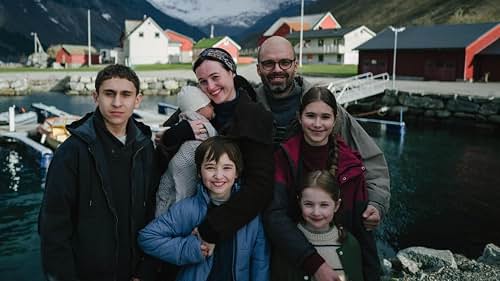
In Fjord, this year’s Palme D’or winner at Cannes Film Festival, Lisbet (played by Renate Reinsve) and Mihai Gheorghiu (played by Sebastian Stan) are an evangelical Christian couple with five children who have moved to a community in Norway to be closer to Lisbet’s family. After a schoolteacher finds marks on one of the children’s bodies, the family finds themselves in the middle of an investigation by Child Services, and the children are taken away and temporarily put into foster homes for the duration of the investigation.
As the movie progresses, the viewer is confronted with a moral dilemma regarding the equity of the situation, as we’re forced to consider both the conservative, religious family’s viewpoints alongside the progressive views of the town they live in. The children state that their parents have hit them before in their written statements, and Mihai does admit that he “slaps his children on the butt” occasionally. However, it is hinted that he did not cause the specific bruises that caused the schoolteacher to report the family to Child Protective Services.
While watching the film, I did find myself supporting the family a little bit. They were outliers in a relatively homogeneous society, and were viewed unfavorably by their neighbors even though the parents made positive contributions to the town (Lisbet is a nurse at the local old folk’s home and also volunteers to take care of her neighbor’s grandfather, Mihai works for the school’s IT department), but there was one detail revealed in the movie that shifted my perspective.
A different teacher at the children’s school, Frida, shares with the Gheorghiu family’s neighbor, Mia, that she also submitted an earlier report to Child Services after the Gheorghiu’s youngest daughter told a classmate that she will go to hell for being a lesbian. Personally, I don’t believe that the child truly believed that her classmate was going to hell, or that she fully understood what that even meant. We don’t even know of the classmate of hers actually identifies as a lesbian, or if she meant to say something else and expressed herself with the vocabulary and knowledge at her disposal (the child who said she was a lesbian was eight years old in the movie). Young kids are very impressionable, and sometimes just repeat whatever they are told without understanding what they are saying.
When I was younger, I believe it was in the second or third grade, our class was making goodie bags to take home to our family for Christmas. The teacher told us all to write “Merry X-mas” on our bags, and I remember immediately telling her that we can’t write “X-mas” because that’s “crossing out Christ”. One of my Sunday School teachers had told this to us, and I assumed that because an adult was telling this to us, that we had to follow what they were saying or else we would go to hell. Obviously now, I don’t care and I know it wasn’t the teacher’s intention to “cross out Christ”, but based off of my knowledge then and the upbringing I had as a Catholic, it was what felt right to me. I didn’t know any better.
As an ex-Catholic who is now an atheist, I believe that religion should be something taught to people once they become adults and have the choice and freedom to study it on their own, but realistically in our society it doesn’t seem possible. For many people, religion is too closely intertwined with their everyday lives. So, when families involving their kids in religion is inevitable, how do we allow people to maintain their religious freedom while also preventing children from becoming indoctrinated with hateful rhetoric?
It’s tough to say what the correct answer is. While it’s unclear whether or not the children in Fjord were being abused physically, I do believe that they were being abused psychologically based off of how they acted with other people outside of their family throughout the film. I’d like to think that years after the events of this film, the two older kids somehow kept in contact with Noora and began to develop a life outside of their family and what they’ve been taught, and they start to make decisions for themselves when it comes to what to believe.


Leave a Reply