This past week, I had the pleasure of watching Lee Chang Dong’s newest movie, Possible Love, at the Egyptian Theater in Hollywood on a rare 35mm print (I believe they told us we were watching the only 35mm print available of Possible Love). It’s a night I had been looking forward to for almost two months for several reasons: 1) Lee Chang Dong is one of my favorite directors and 2) because there was a Q&A with the director and the cast, the first time I had been to an event like this. Needless to say, this film (and the whole experience) did not disappoint. Lee is a director that doesn’t shy away from putting a spotlight on the experiences that aren’t always highlighted in mainstream cinema discussions, from society’s views on people with disabilities in Oasis, to people’s internal battles with faith amidst crisis in Secret Sunshine. Possible Love continues Director Lee’s excellence in shining a light on the human experience with the same emotional depth as his previous films, but with a little bit of unexpected comedy.
According to Director Lee, the inspiration for this film began over ten years ago, when a mass layoff at a major Korean company prompted a workers’ strike, leading to a violent suppression of the strike by police, shocking people across the country. However, while creating a narrative inspired by these events, Lee began to wonder if he was worthy of even telling the story himself. There was already a documentary about the film, and he also had moral quandaries around whether or not he had the right to even use this narrative to create a film. So, he stopped the production of the film until two years ago when the co-writer of Possible Love, Oh Jung Mi, suggested that Lee add a filmmaker/documentary aspect to the narrative and talk about the attitude of the filmmaker and the ethics of film in relation to the story inspired by the worker’s strike. Thus, production of the movie officially began.
Possible Love touches on many themes (what labor and work mean in a world that is rapidly industrializing and digitizing, the ethics behind documentaries and filmmaking, class and socioeconomic status, just to name a few) but at no point does the combination of themes in the narrative feel overwhelming. His films understand that these themes don’t operate independently of each other, and highlight the tension between opposing views and personalities to put our characters on a journey of self-discovery and healing.
The film starts off with a simple quote: “Thou shall not covet.” Notably, it is the tenth commandment, and also a tribute to Krzysztof Kieslowski’s Dekalog: Ten, setting the stage for a conflict between ownership of wealth, opportunity, and emotion. We see our main quartet of characters meet for the first time when married couple Mi-ok, a mask factory worker, and Ho-seok, a factory welder, attend a funeral with their son, Cheol, to pay respects to a former coworker who has committed suicide. When Ho-Seok sees Ye-ji, a documentary filmmaker, filming him and his wife having an argument over his drinking, he shouts at her, prompting Mi-ok to leave the funeral where she meets Sang-woo, Ye-ji’s wealthy husband. The altercation convinces Ye-ji to make Ho-seok and Mi-ok the subject of her documentary, thus beginning a complicated relationship between the two couples.
Mi-ok is very open to being filmed for Ye-ji’s documentary from the very beginning. She’s unashamed in talking about her upbringing and her struggles. In her initial meeting with Ye-ji, Mi-ok brings up a childhood story of her playing with a hose at her mother’s car wash job because she loved being the rainbow in the water, but her mother, upon seeing that sight, snatched the hose out of her hand because she didn’t want to see her daughter also pursuing the same career path as her.
One might say that Mi-ok is innocent, but I see her as someone who is trusting and wants to believe that people will always do the right thing. At a dinner with the two couples, Mi-ok and Ye-ji decide to forgo polite speech and use informal speech with each other, a sign of friendship in Korean culture. She wants to help Ye-ji create a good documentary, going as far as to start a union at her job in an effort to give Ye-ji more content to film. As the characters begin to get closer, we see the ways Ye-ji begins to take advantage of Mi-ok’s trust in an effort to get what she really wants—an interview with her husband Ho-seok.
Ho-seok is reluctant to speak with Ye-ji due to the trauma he developed during the worker’s strike at his previous company. During a violent suppression of the strike by the police, he was left behind by his coworkers and brutally beaten by police, to the point where he passed out twice. The feelings of betrayal left him feeling disappointed and unwilling to take group therapy for people who had been laid off from their jobs. Ye-ji is frustrated by the inability to get an interview from Ho-seok, who she believes is the real star of the documentary.
As the two couples get closer, we being to learn more about Ye-ji and Sang-woo as individuals as well. While Sang-woo is a very wealthy man, Ye-ji is rumored not to receive any financial help from her husband to do her projects. Her passion to tell this narrative about the worker’s strike and the following aftermath seem genuine, but it’s very clear that her ultimate goal isn’t to befriend people like Mi-ok and Ho-seok because she empathizes with them and wants to truly help them, but is to create a successful film, no matter how difficult it may seem. Her husband, Sang-woo, is a man who moves with the ease of someone who knows he doesn’t have to worry about where his next meal comes from. He’s a handsome, rich man who is supportive of his wife’s endeavors as a filmmaker, but also is quick to point out that she is not like the workers she is filming, reminding her of their privileged status compared to people like Mi-ok and Ho-seok. Sang-woo also begins to develop a certain flirtatious back-and forth with Mi-ok, as the two couples begin to get closer, adding more tension in the story.
The slowly brewing chess match of emotions culminates in a trip to Sang-woo’s private home near the coast, where Ye-ji finally gets the chance to interview Ho-seok. Throughout the film, as the characters interacted with each other, we feel the lines between socioeconomic class begin to blur, as the characters break down their emotional walls and develop a working relationship together. However, the luxurious getaway at this private home is where everyone is reminded of where their place is in society. The poor are still the poor, and the rich are still the rich.
Sang-woo’s home is where Ho-seok is opens up in front of the camera about his experiences during and after the worker’s strike, and how he has been unable to grapple with the betrayal he felt from seeing his coworkers leave him behind to be brutally assaulted by the police. During the first interview, as he continues to recollect his experiences, he becomes so overwhelmed by the memories that he begins to have a panic attack. When this happens, you can see Ye-ji hesitate to approach him and comfort him until she feels she got the shots that she needed, showcasing that no matter how much Ye-ji may empathize with his feelings, at the end of the day, she is there to get the content she needs for her documentary.
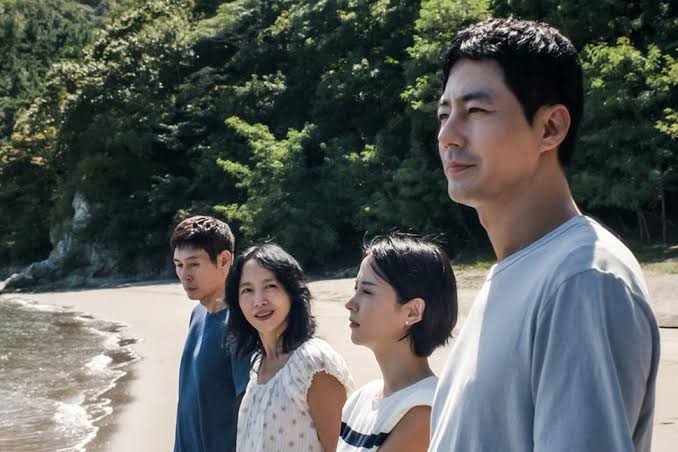
The trust between Mi-ok and Ye-ji also begin to break down as the trip continues. When everyone first arrives at the private home, Sang-woo takes them to the beach where he used to go swimming as a kid. He mentions that it was a private beach, so he used to go swimming naked since no one else could watch him. I thought it was an interesting moment to mention within the context of the film. As someone who grew up wealthy, Sang-woo had access to privacy and the ability to do whatever he wants without anyone else around him to tell him what to do. It serves as a sharp contrast to a moment later in the film where Ho-seok has an outpouring of emotions in the middle of the night on the beach while trying to wrestle with his feelings. When Mi-ok follows him down (without him knowing), she understands that Ho-seok is doing this because he doesn’t want anyone else to see him unraveling, but she turns around to see Ye-ji quietly following them with a film camera, hoping to obtain footage of his breakdown.
As people from a lower class, Mi-ok and Ho-seok aren’t afforded the same level of privacy that rich people are. Without saying a word, Ye-ji and Sang-woo have “othered” Mi-ok and Ho-seok, showing them that they are of a different socioeconomic status than them. They are simply pawns for Ye-ji’s personal gain.
There’s a moment where Mi-ok sees her son, Cheol, with the groundskeeper of the house. The groundskeeper is watching Cheol spray the hose on the bushes, admiring the rainbow in the water. We see the complicated emotions in Mi-ok’s face, as she begins to understand why her mother felt the way she did when she saw her spray the hose at the car wash, further making her realize that she is not welcome at his private home as an equal, but rather as an outsider, a guest who will only be here temporarily until she goes back to her regular life as a factory worker.
The tensions bubble over towards the end of the film when Mi-ok and Sang-woo go to the beach for the last time. Throughout the movie, these two characters have maintained a flirtatious energy, but nothing substantial happened between the two. The two end up going skinny dipping, and Sang-woo attempts to make a move on Mi-ok several times, but she rejects every single one. In this moment, Mi-ok understands that she isn’t seen as a person, but rather, a commodity, someone who is being used to further another person’s career or satisfy someone’s momentary needs. This convinces Mi-ok to tell her husband not to film the documentary anymore, and they leave the private home without looking back.
Before they leave, there’s a small conflict between the couples over a family heirloom, a whistle to be specific. Ye-ji asks if Mi-ok and Ho-seok took the whistle, hinting that she thinks they stole it, to which Mi-ok responds indignantly, telling her they would do no such thing and that she can even search their bags before they leave. It’s leaves the viewer with a final question as the film comes to a close: Why is it acceptable for the rich to steal from the poor, but it’s unacceptable to even think that a poor person could take something from the rich? We spend the whole movie seeing Ye-ji take Mi-ok and Ho-seok’s emotions and stories for her own personal gain and getting nothing in return, but when an opportunity reveals for the roles to be reversed, albeit in a different context, the lines in the sand are drawn and statuses are firmly established for the two couples. In the end, it turns out that the son took the whistle, but they don’t bother turning back to return it.
———
Possible Love is not a film that has an overwhelming emotional ending or big discovery, but I think that’s why the film is so good. It doesn’t attempt to sugarcoat or dramatize class struggles and moral conflicts for the sake of entertainment, but instead observes the little ways they affect interpersonal relationships and personal desires. I thought it was a realistic journey of self-discovery that ends rather positively for a Lee Chang Dong film, and felt apt for the times we are in now.
It was heartwarming to see Lee Chang Dong reunite with a lot of talents he had previously worked with, namely Jeon Do Yeon who won Best Actress at Cannes Film Festival with Secret Sunshine, and Sul Kyung Gu, who worked with Director Lee on Oasis and Peppermint Candy. You also see a lot of familiar faces in the supporting cast as well, and as a fan of Director Lee’s films, it almost felt like a family reunion.
This film is one of the best, if not the best film that has been released in 2026, and I strongly recommend that everyone takes the time to watch it. Although the run time is quite long (2 hours and 44 minutes), I never felt myself thinking that the film was too long. The narrative captivated me for the entire runtime, and reminded me why Lee Chang Dong is one of the best directors alive.
NOTE: If you haven’t watched Heartbeat, Lee Chang Dong’s 2022 short film, I highly suggest you do so. It feels like a spiritual precursor to Possible Love, and also stars Jeon Do Yeon and Seol Kyung Gu as well.


Leave a Reply